
Choosing The Right Drum For Hazardous Materials
Packing group, specific gravity, head style, and chemical compatibility all decide which drum can safely carry your product. Here is what to check before you order.
Start with the product
Two drums can look identical and still be certified for very different jobs. Choosing well starts with your product, not the catalog. Before comparing sizes or prices, gather the facts that decide which drums are even allowed.
Check the Safety Data Sheet
Section 14 of the Safety Data Sheet usually lists the UN number, hazard class, and packing group. Section 9 lists the relative density, which is the same figure as specific gravity. Together they set the minimum rating your drum must carry. A drum rated for packing group II cannot legally ship a packing group I product, however sturdy it looks.
Tight-head or open-head
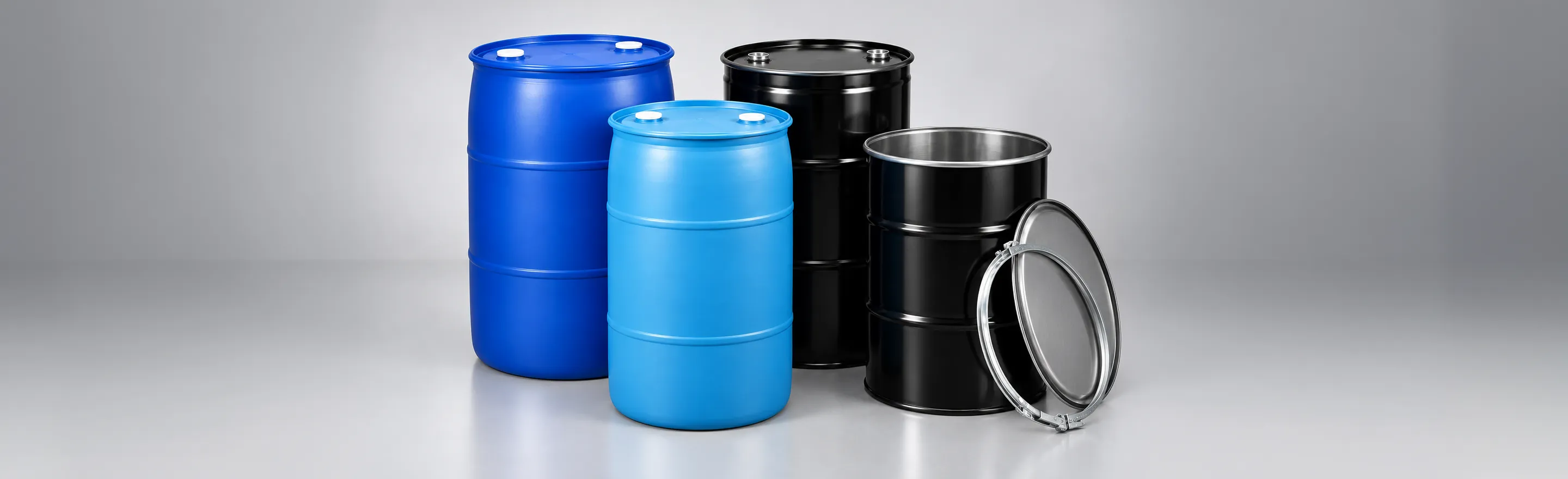
Tight-head drums have a fixed top with small threaded openings, called bungs, usually one 2-inch and one 3/4-inch, and are the usual choice for free-flowing liquids. Open-head drums have a fully removable lid held by a ring, which makes them easier to fill and empty with solids, powders, and thick products. Many open-head drums are rated for solids only, so confirm the marking before you plan to ship a liquid in one.
Plastic or steel
- Plastic (HDPE) drums: resist many acids and corrosives that would attack bare steel, weigh less, and will not rust.
- Steel drums: suit many flammable solvents and products that are not compatible with plastic.
- Lined steel drums: add an interior coating, or a polyethylene liner, for products that would react with bare steel.
Not sure which drum fits?
Tell us what you are packaging and we will come back with options, pricing, and lead times.
Request a quoteDo not skip compatibility
A drum can carry the right rating and still be the wrong choice. Some solvents attack or permeate plastic over time, while acids such as sulfuric and nitric acid corrode unlined steel. When in doubt, test with your actual product or ask for compatibility guidance before you commit to a full order.
Bringing it together
- Confirm the packing group and specific gravity from the Safety Data Sheet.
- Match the head style to how you fill and empty.
- Choose the material that is compatible with your product.
- Check that the UN marking meets or exceeds every requirement.
With those answers in hand, choosing a drum becomes a short list instead of a guess. Tell the Inmark team what you are shipping, and we will help you match it to the right drum, in stock and ready to ship.
Keep reading



Talk to a packaging specialist
Tell us what you need to ship and we will help you get it there safely and on time.